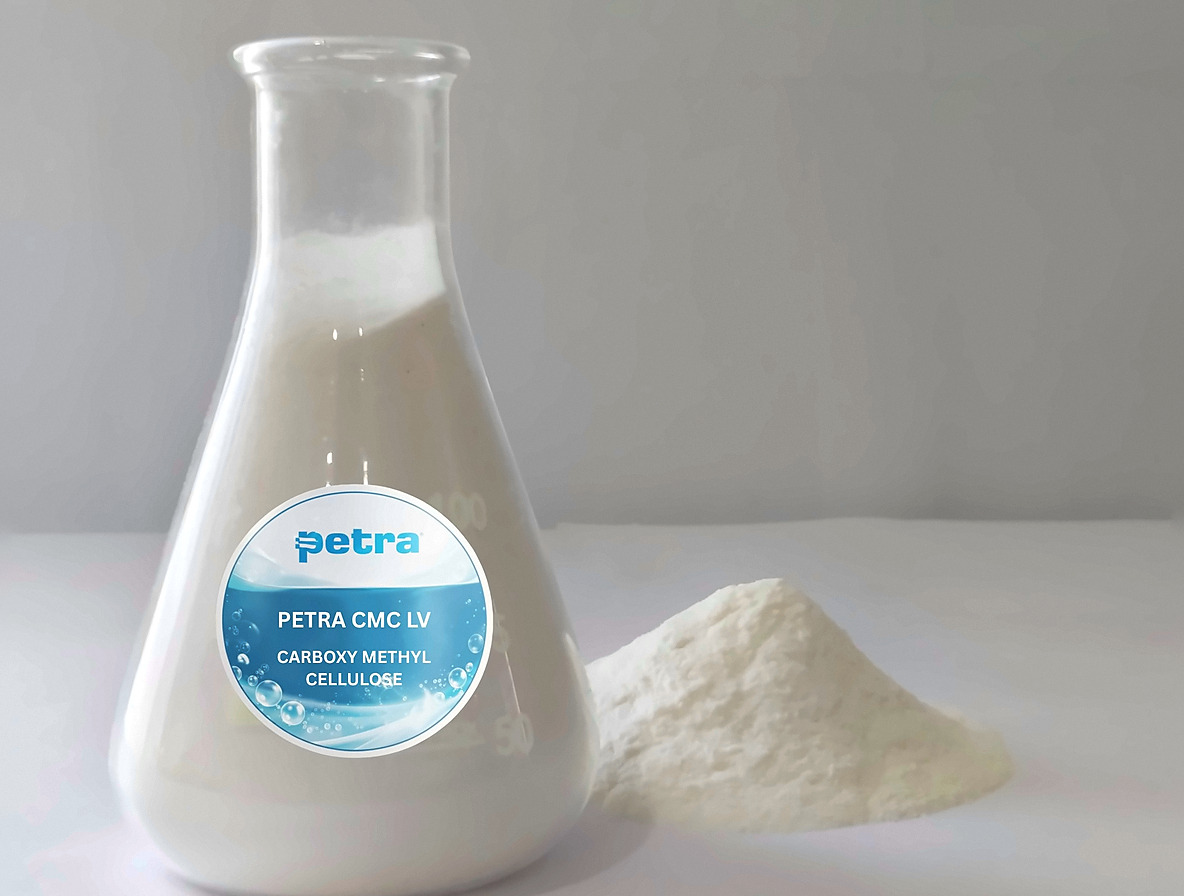
CMC LV (Low-Viscosity Carboxymethyl Cellulose) is a water-soluble polymer used in water-based drilling fluids primarily as a fluid-loss-control additive. It forms a thin, low-permeability filter cake on the wellbore wall, helping reduce filtrate invasion into permeable formations while maintaining relatively low impact on drilling-fluid viscosity.
Compared with higher-viscosity CMC grades, CMC LV is designed to provide fluid-loss control with a relatively smaller increase in bulk mud viscosity. This makes it useful where filtration control is required while maintaining manageable rheological properties and good pumpability.
CMC LV can also contribute to filter-cake quality, wellbore stability, and suspension properties. Its performance depends on factors such as concentration, water chemistry, salinity, hardness, temperature, and the other additives present in the drilling-fluid system.
Its primary purpose is to control the amount of liquid filtrate passing from the drilling fluid into permeable formations. By reducing filtrate invasion, CMC LV helps maintain wellbore stability, improve filter-cake quality, and minimize excessive interaction between the drilling fluid and formation.
The low-viscosity grade is particularly useful when filtration control is required without creating a significant increase in plastic viscosity or yield point. It can therefore help maintain good pumpability, hydraulics, and solids-transport characteristics of the drilling fluid.
Main Technical Functions
i)Fluid-loss reduction – controls API filtration and limits filtrate invasion.
ii)Filter-cake formation – produces a thin, compact, low-permeability filter cake.
iii)Wellbore protection – helps reduce excessive fluid penetration into permeable formations.
iv)Rheology control – provides controlled viscosity with relatively low rheological impact.
v)Suspension support – assists in maintaining fine solids within the mud system.
vi)Formation protection – helps minimize potential formation-fluid interaction and damage.
vii)Mud stability – contributes to consistent filtration performance during drilling.
Advantages
Excellent fluid-loss control – helps reduce filtrate loss into permeable formations.
Thin filter cake formation – produces a relatively thin and low-permeability filter cake.
Low rheological impact – provides filtration control without significantly increasing mud viscosity.
Improves wellbore stability – helps maintain a stable filter cake along the wellbore wall.
Reduces filtrate invasion – limits excessive penetration of liquid into the formation.
Good water solubility – readily hydrates and disperses when properly mixed.
Supports good pumpability – its low-viscosity grade helps maintain manageable mud rheology.
Improves filter-cake quality – contributes to a compact and uniform cake.
Helps protect formations – reduces unwanted interaction between filtrate and permeable formations.
Supports solids suspension – can provide some viscosity contribution for maintaining fine solids in suspension.
Easy to formulate – can be incorporated into various water-based mud systems.
Effective at controlled concentrations – suitable where filtration control is required without excessive viscosity buildup.