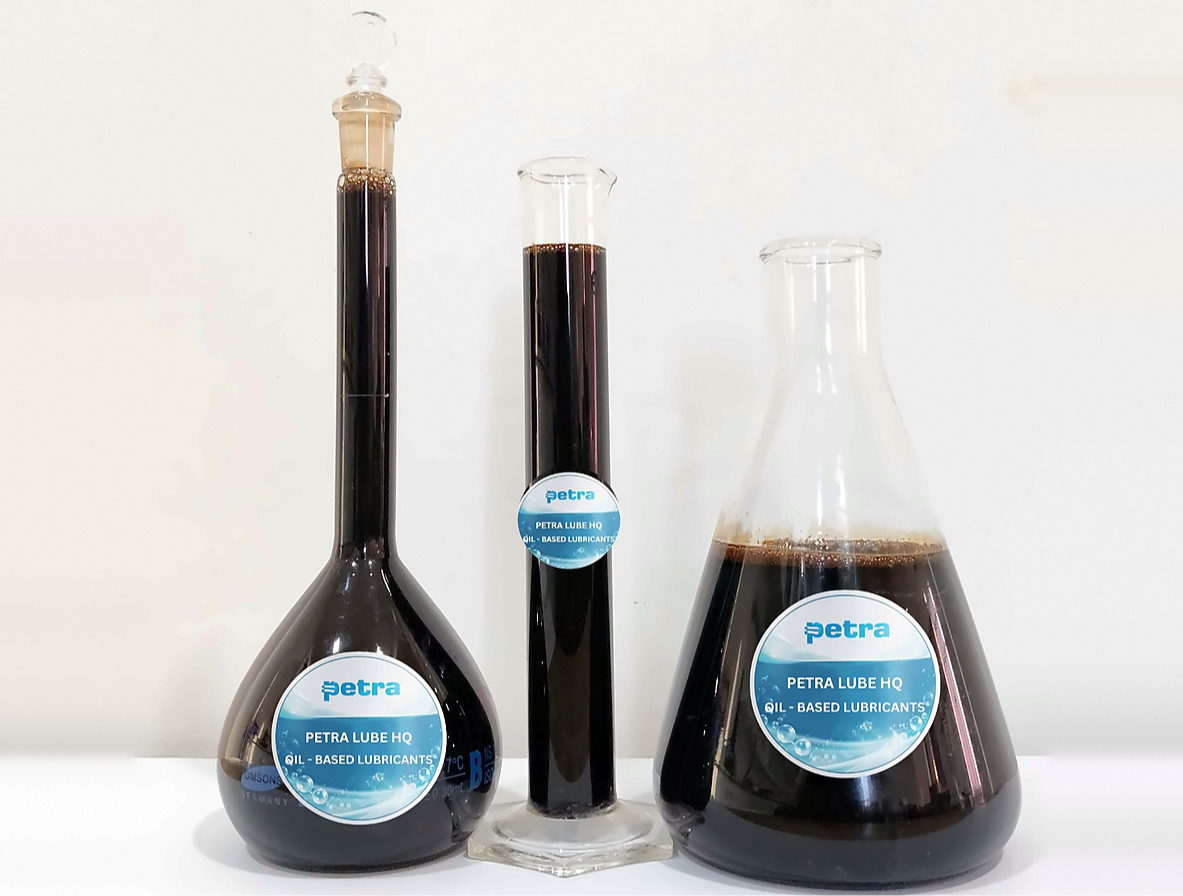
An oil-based lubricant is a lubricating additive used in drilling fluids to reduce friction between the drill string, wellbore wall, casing, and formation. It is commonly used in oil-based mud (OBM), invert-emulsion mud, and sometimes compatible water-based systems.
An oil-based lubricant is a hydrocarbon-compatible drilling-fluid additive designed to reduce the coefficient of friction between the drill string, wellbore wall, casing, and formation. It forms a persistent lubricating film on contacting surfaces, reducing torque, drag, mechanical wear, and frictional resistance. It is particularly useful in OBM/invert-emulsion systems and high-angle, directional, horizontal, and extended-reach wells where drill-string contact and friction are significant.
An oil-based lubricant is a specially formulated oil-compatible surface-active additive used in drilling fluids to improve lubricity under downhole conditions. It adsorbs onto metal and formation surfaces to create a low-shear-strength lubricating film, reducing the coefficient of friction between the drill string, casing, and wellbore. This helps control torque and drag, reduce mechanical wear, improve drill-string mobility, and minimize friction-related sticking, particularly in directional, high-angle, horizontal, and extended-reach wells.
Main Uses in Drilling
i)Reduces friction between drill string and wellbore/casing.
ii)Controls torque and drag during drilling, tripping, and sliding.
iii)Improves drill-string rotation and sliding efficiency.
iv)Reduces mechanical wear on drill pipe, tool joints, and casing.
v)Helps minimize friction-related sticking.
vi)Supports smoother drilling in directional and high-angle wells.
vii)Particularly useful in horizontal and extended-reach wells.
viii)Helps reduce mechanical energy losses caused by friction.
ix)Maintains lubricity under elevated temperature and pressure, depending on formulation.
x)Helps improve overall drilling efficiency and BHA performance.
xi)Can support improved ROP when friction is a significant drilling limitation.
xii)Helps provide continuous surface lubrication between contacting downhole surfaces.
Advantages
i)Reduces torque and drag during drilling operations.
ii)Provides effective lubrication between drill string and wellbore surfaces.
iii)Reduces mechanical wear of drill pipe, tool joints, and casing.
iv)Improves drill-string rotation and sliding performance.
v)Helps minimize friction-related sticking.
vi)Provides good lubricity in directional, high-angle, and horizontal wells.
vii)Helps maintain lubricity under high-temperature downhole conditions, depending on formulation.
viii)Reduces frictional energy losses during drilling.
ix)Supports smoother BHA movement and wellbore navigation.
x)Can contribute to improved drilling efficiency and ROP when friction is limiting performance.
xi)Helps extend the service life of drilling components by reducing contact wear.
FAQ:
Q1. What is the main function of an oil-based lubricant in drilling fluids?
Answer: Its main function is to reduce friction between the drill string, wellbore, casing, and formation, thereby controlling torque, drag, and mechanical wear.
Q2. How does an oil-based lubricant reduce friction?
Answer: It adsorbs onto contacting surfaces and forms a low-friction lubricating film, which reduces direct surface-to-surface contact and lowers the coefficient of friction.
Q3. Why is oil-based lubricant important in directional drilling?
Answer: Directional and horizontal wells have greater drill-string contact with the wellbore. The lubricant helps reduce torque, drag, and rotational resistance, improving drill-string movement.
Q4. How does it affect torque and drag?
Answer: By reducing friction at the drill-string/wellbore interface, it can lower rotational torque and axial drag during drilling, sliding, and tripping operations.
Q5. How does an oil-based lubricant help reduce equipment wear?
Answer: The lubricating film reduces frictional contact, helping minimize wear on drill pipe, tool joints, casing, and other contacting components.
Q6. Can oil-based lubricant help prevent sticking?
Answer: It can reduce friction-related mechanical sticking and may help with differential-sticking tendency, but differential sticking also depends on factors such as filter-cake properties and overbalance pressure.
Q7. Where is oil-based lubricant particularly useful?
Answer: It is particularly useful in OBM/invert-emulsion systems, directional wells, high-angle wells, horizontal wells, and extended-reach drilling.
Q8. Does oil-based lubricant directly increase ROP?
Answer: Not necessarily. It may support higher ROP when friction and torque are limiting factors, but ROP also depends on formation, bit, hydraulics, weight-on-bit, and other drilling parameters.
Q9. What properties should be considered when selecting an oil-based lubricant?
Answer: Important properties include lubricity, thermal stability, compatibility with the mud system, emulsion stability, formation compatibility, environmental requirements, and resistance to degradation.
Q10. What is the key technical advantage of an oil-based lubricant?
Answer: Its key advantage is effective friction reduction, helping control torque and drag while improving drill-string mobility and reducing mechanical wear during drilling.