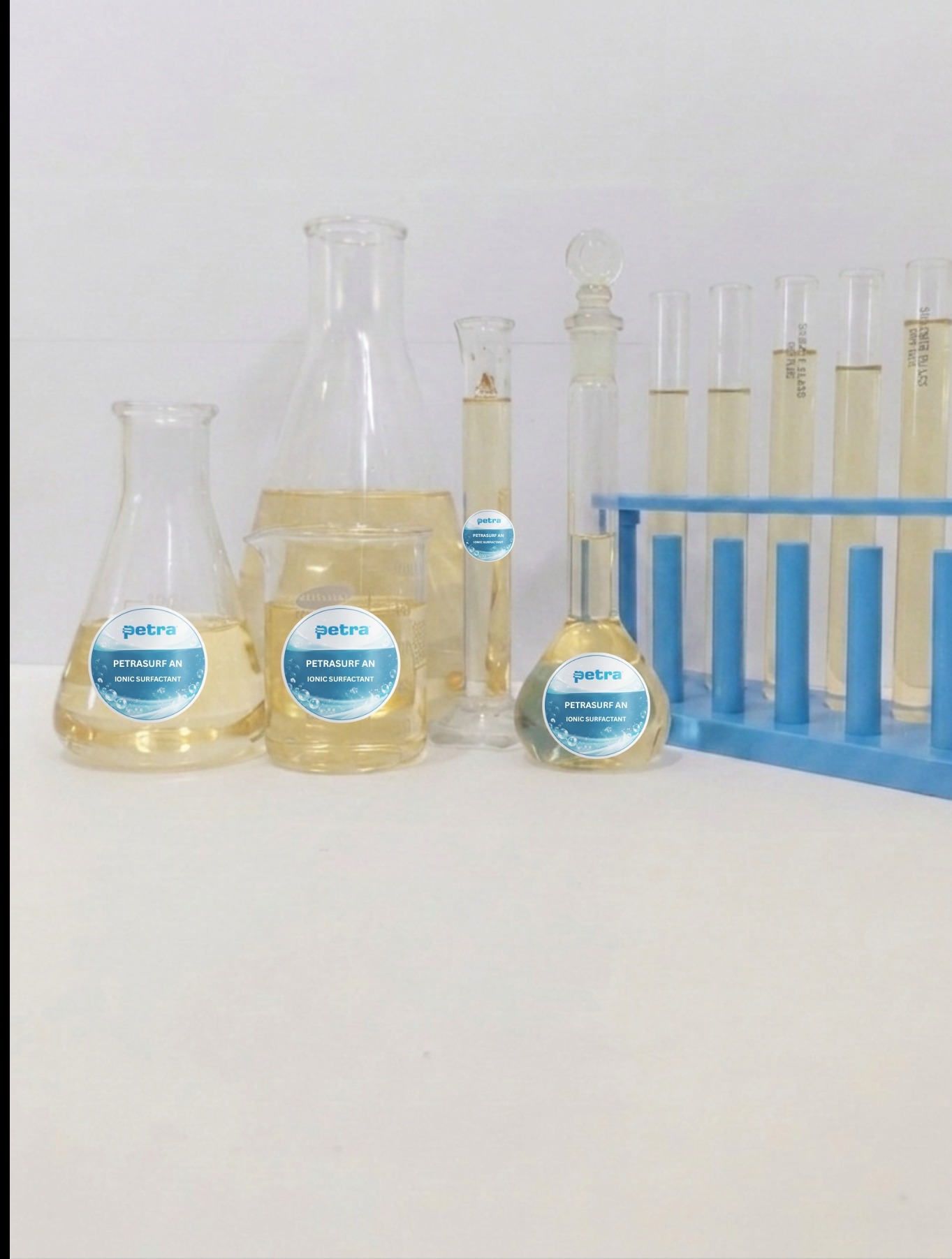
Anionic surfactant is a surface-active chemical that carries a negative charge on its hydrophilic group. It is used in suitable drilling-fluid formulations to improve wetting, detergency, dispersion, and removal of contaminants.
An anionic surfactant is a negatively charged chemical additive used in water-based and sodium-based drilling muds to improve emulsion, control fluid loss, and reduce torque and drag.
Main uses in drilling
i)Wetting agent: Improves wetting of selected solids and surfaces.
ii)Detergency: Helps remove oil, grease, and contaminants during cleaning.
iii)Dispersion: Assists in dispersing suitable particles in water-based systems.
iv)Emulsification: Helps form emulsions in compatible formulations.
v)Surface cleaning: Supports cleaning of drilling equipment and contaminated surfaces.
Advantages
i)Provides effective wetting and cleaning.
ii)Can improve contaminant dispersion.
iii)Offers good detergency in suitable formulations.
iv)Can support the performance of water-based cleaning systems.
v)May improve additive distribution when properly selected.
FAQ:
Q1. What is an anionic surfactant? Answer: A surfactant whose hydrophilic group carries a negative electrical charge in solution.
Q2. What is its main function in drilling fluids? Answer: It improves wetting, detergency, and dispersion, depending on the drilling-fluid formulation.
Q3. Which chemical groups are commonly found in anionic surfactants? Answer: Common groups include sulfate, sulfonate, and carboxylate groups.
Q4. Can anionic surfactants be used in water-based mud? Answer: Yes. Compatible grades can be used for wetting, cleaning, or dispersion in water-based drilling fluids.
Q5. What factors affect anionic surfactant performance? Answer: Salinity, water hardness, pH, temperature, concentration, and interactions with other additives.
Q6. What is the difference between anionic and non-ionic surfactants? Answer: Anionic surfactants carry a negative charge on their hydrophilic group, whereas non-ionic surfactants have no electrical charge on that group.
Q7. Can anionic surfactants be used in oil-based mud? Answer: Certain specialized grades may be suitable, but compatibility with the base oil and emulsifier system must be verified. Many conventional anionic surfactants are primarily designed for aqueous systems.