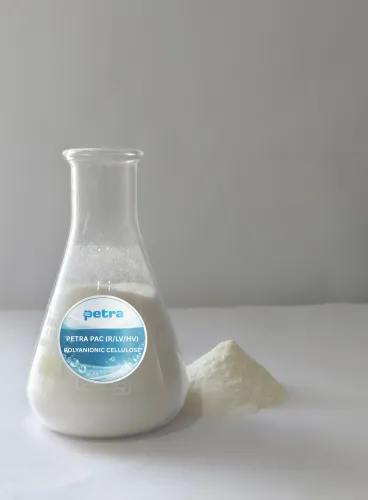
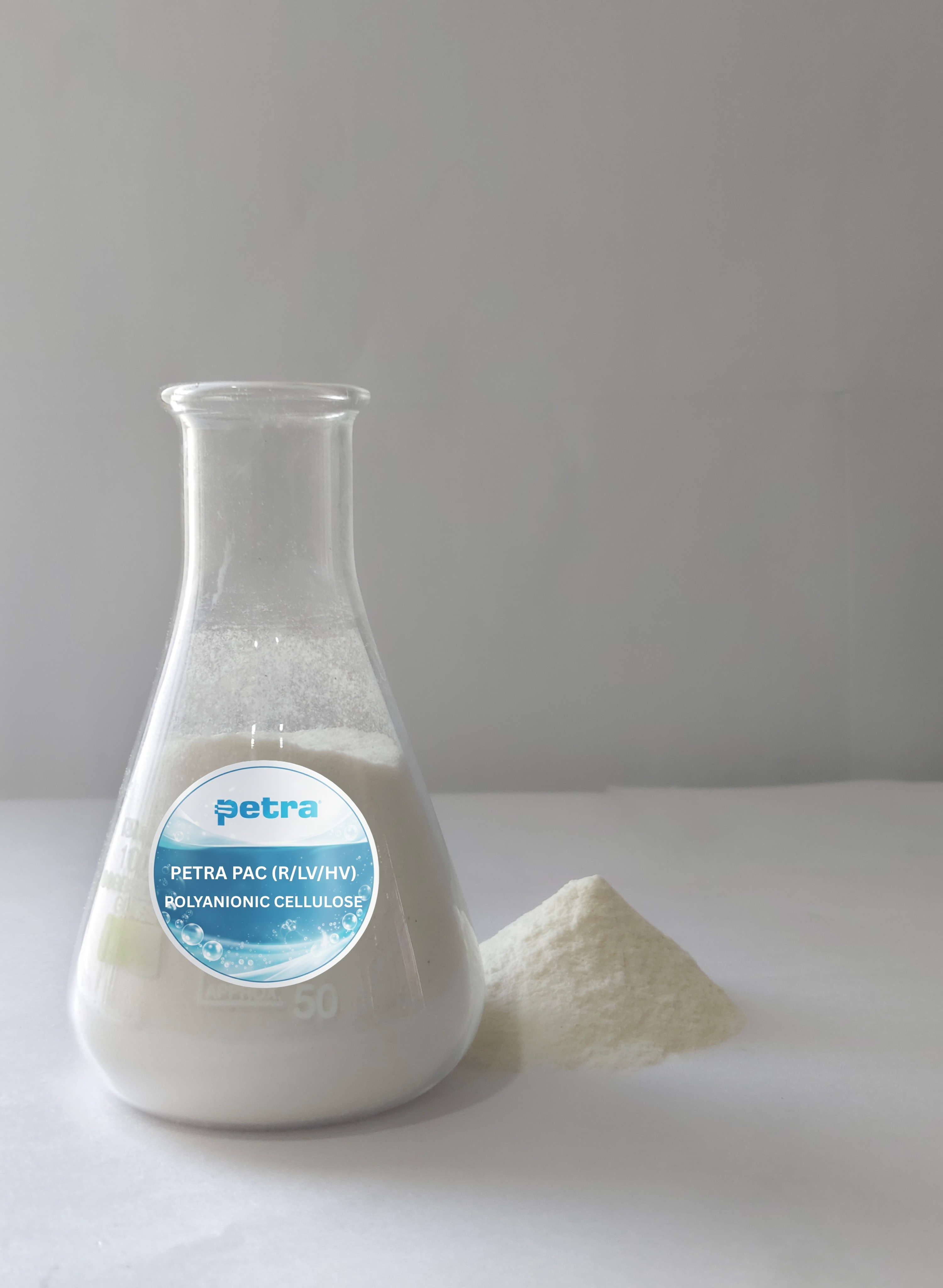
Polyanionic Cellulose Regular (PAC) is a water-soluble cellulose-based polymer used in water-based drilling fluids to control fluid loss, improve viscosity, and stabilize the wellbore.
PAC is a water-soluble polymer used in water-based drilling fluids to control fluid loss, improve viscosity, and form a low-permeability filter cake. It helps reduce filtrate invasion into formations and supports wellbore stability.
PAC (Polyanionic Cellulose) is a water-soluble drilling-fluid additive used mainly for fluid-loss control and filter-cake formation in water-based mud systems.
Main uses in drilling
i)Fluid-loss control: Reduces filtrate loss into permeable formations.
ii)Viscosity enhancement: Helps increase drilling-fluid viscosity.
iii)Shale stabilization: Supports wellbore stability by reducing water invasion when used in a suitable formulation.
iv)Filter-cake formation: Helps form a thin, low-permeability filter cake.
v)Suspension: Assists in keeping fine solids suspended in the drilling fluid.
Advantages
i)Effective fluid-loss control.
ii)Water-soluble and easy to mix when properly hydrated.
iii)Available in low-viscosity (PAC-LV) and high-viscosity (PAC-HV) grades.
iv)Suitable for many freshwater and saline water-based mud systems, depending on grade and salinity.
FAQ:
Q1. What is PAC in drilling fluids? Answer: PAC is a polyanionic cellulose polymer used mainly for fluid-loss control and, depending on grade, viscosity enhancement.
Q2. What is the difference between PAC-LV and PAC-HV? Answer: PAC-LV primarily controls filtration with limited viscosity increase, while PAC-HV provides fluid-loss control and greater viscosity enhancement.
Q3. Is PAC water-soluble? Answer: Yes, PAC is generally water-soluble and is commonly used in water-based drilling fluids.
Q4. What is the main benefit of PAC? Answer: It reduces fluid loss and helps maintain drilling-fluid and wellbore stability.