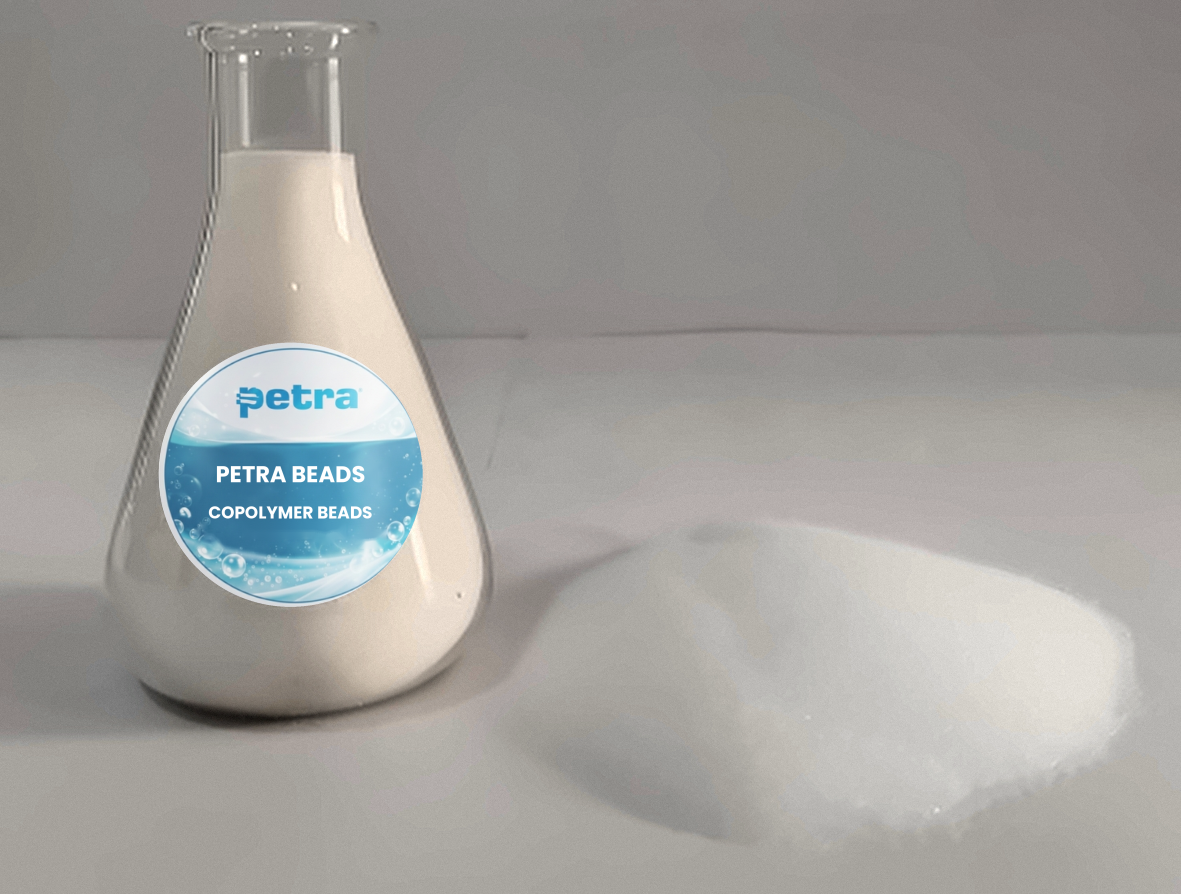
Copolymer beads are polymeric, spherical or granular materials used as lost-circulation and wellbore-strengthening additives in drilling fluids. They can help bridge and seal microfractures, pores, and weak formations, reducing fluid invasion and maintaining wellbore stability.
Copolymer beads are engineered polymeric particles used in drilling fluids to provide pore and fracture sealing, wellbore strengthening, and fluid-loss control. Their controlled particle size allows them to bridge small pores and microfractures, forming a low-permeability seal that helps minimize filtrate invasion and maintain wellbore stability.
Main uses in drilling
i)Synthetic polymer-based spherical particles used as a drilling-fluid additive.
ii)Provide bridging and sealing of pores, microfractures, and formation openings.
iii)Help reduce fluid invasion and filtrate loss.
iv)Improve wellbore stability and formation integrity.
v)Can function as a lost-circulation and wellbore-strengthening material (LCM/WSM).
vi)Particle size can be selected according to the formation pore/fracture size.
vii)Often used in combination with other bridging materials for improved sealing performance.
viii)Lost Circulation Control (LCM): Help reduce drilling-fluid losses into permeable or fractured formations.
ix)Wellbore Strengthening: Form a sealing layer across small fractures and weak zones.
x)Pore/Fracture Sealing: Plug microfractures and pore throats to reduce mud-filtrate invasion.
xi)Fluid-Loss Reduction: Improve the sealing capability of the filter cake and reduce filtrate loss.
xii)Wellbore Stability: Help prevent formation weakening, sloughing, and instability caused by fluid invasion.
xiii)Fracture Propagation Control: Can help seal existing fractures and reduce further propagation under drilling pressure.
xiv)Formation Protection: Reduce interaction between the drilling fluid and sensitive formations.
xv)Differential-Sticking Prevention: By improving filter-cake quality and reducing excessive filtrate invasion, they may help lower sticking risk.
Advantage
i)Improves wellbore stability by sealing weak formations.
ii)Reduces fluid loss into permeable formations and microfractures.
iii)Provides effective bridging across pores and small fractures.
iv)Reduces formation-fluid invasion and helps maintain formation integrity.
v)Helps control lost circulation in low- to moderate-severity loss zones.
vi)Improves filter-cake quality and reduces permeability.
vii)Helps reduce differential sticking risk by limiting excessive filtrate invasion.
viii)Supports wellbore strengthening and improves pressure containment.
ix)Compatible with various drilling-fluid systems, depending on polymer chemistry.
x)Can work synergistically with other LCM materials such as graphite, calcium carbonate, fibers, and nut shells.
FAQ:
Q1. What are copolymer beads used for in drilling fluids?
Answer: They are mainly used for pore/fracture sealing, fluid-loss control, lost-circulation control, and wellbore strengthening.
Q2. How do copolymer beads control fluid loss?
Answer: They bridge pores and microfractures and form a low-permeability sealing layer, reducing drilling-fluid filtrate invasion.
Q3. How do copolymer beads improve wellbore stability?
Answer: They seal weak and permeable zones, reducing fluid invasion and helping maintain formation integrity.
Q4. Can copolymer beads be used as an LCM?
Answer: Yes. Depending on their formulation and particle size, they can function as lost-circulation material (LCM) for sealing fractures and loss zones.
Q5. What is the main technical function of copolymer beads?
Answer: Their main function is bridging and sealing formation pores and microfractures to control fluid invasion and strengthen the wellbore.
Q6. What determines the effectiveness of copolymer beads?
Answer: Performance depends mainly on particle-size distribution, polymer chemistry, concentration, compressibility, and compatibility with the drilling-fluid system.
Q7. Can copolymer beads be combined with other LCM materials?
Answer: Yes. They can be combined with materials such as graphite, calcium carbonate, fibers, and walnut shell to create a more effective sealing system.