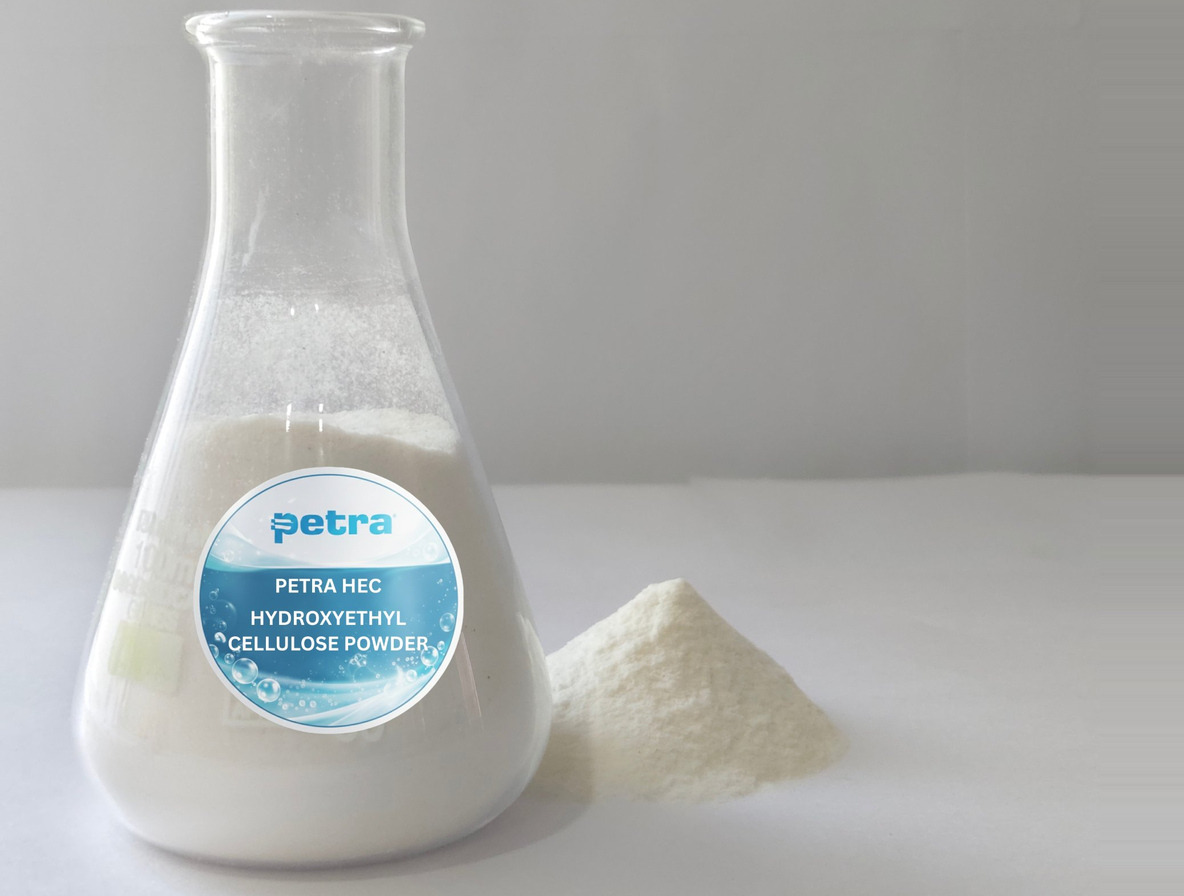
HEC (Hydroxyethyl Cellulose) Powder is a water-soluble, nonionic cellulose polymer used in water-based drilling fluids mainly as a viscosifier, fluid-loss-control additive, and suspension agent. It hydrates in water to increase viscosity and helps maintain the suspension and transport of drilled cuttings.
HEC can form a thin, cohesive filter cake on permeable formations, helping reduce filtrate invasion and support wellbore stability. Its nonionic nature provides useful tolerance to various water chemistries and electrolytes compared with some ionic polymers.
HEC also contributes to filter-cake formation, helping reduce filtrate invasion into permeable formations. Because HEC is nonionic, its performance can be less sensitive to certain electrolyte conditions than some ionic cellulose polymers, making it useful in selected water-based systems.
HEC supports the suspension and transport of drilled cuttings, contributing to effective hole cleaning. It can also improve filter-cake formation on permeable formations, helping reduce filtrate invasion and supporting wellbore stability. Because it is nonionic, HEC can offer useful compatibility with various electrolytes and water chemistries, although performance should always be confirmed under the actual mud conditions.
When properly dispersed and hydrated, HEC develops viscosity in the aqueous phase and improves the drilling fluid's carrying capacity and suspension properties. This helps maintain drilled cuttings in suspension and supports their transportation to the surface, contributing to effective hole cleaning.
HEC can also contribute to fluid-loss reduction and filter-cake formation by increasing the viscosity of the filtrate phase and depositing polymer at the formation surface. This helps reduce excessive filtrate invasion into permeable formations and can support wellbore stability and formation protection.
Main Technical Functions
i)Viscosification: Builds aqueous-phase viscosity and improves carrying capacity.
ii)Cuttings suspension: Helps keep drilled solids suspended during circulation and static periods.
iii)Hole cleaning: Supports transportation of cuttings to the surface.
iv)Fluid-loss control: Helps reduce filtrate invasion into permeable formations.
v)Filter-cake formation: Contributes to formation of a cohesive protective filter cake.
vi)Rheology modification: Helps adjust the flow characteristics of the drilling fluid.
vii)Wellbore protection: Helps limit excessive interaction between filtrate and formation.
viii)Electrolyte compatibility: Nonionic chemistry can provide useful tolerance in selected water chemistries.
Advantages
i)Effective viscosity building – increases aqueous-phase viscosity and improves carrying capacity.
ii)Good cuttings suspension – helps keep drilled solids suspended during circulation and static periods.
iii)Improves hole cleaning – supports efficient transportation of cuttings to the surface.
iv)Fluid-loss control – helps reduce filtrate invasion into permeable formations.
v)Good filter-cake formation – contributes to a cohesive and protective filter cake.
vi)Nonionic polymer – provides useful compatibility with various water chemistries and electrolytes.
vii)Rheology modification – helps adjust and maintain desired mud flow properties.
viii)Supports wellbore stability – reduces excessive filtrate penetration and formation interaction.
ix) Good water solubility – hydrates in water when properly dispersed.
x)Versatile application – can be used in freshwater, brackish-water, and selected saline WBM systems.
xi)Supports solids suspension at low flow rates – useful during reduced circulation or temporary static conditions.
xii)Helps maintain mud consistency – contributes to stable rheological and filtration properties when properly formulated.
FAQ:
1. What is HEC Powder?
Answer: HEC (Hydroxyethyl Cellulose) is a nonionic, water-soluble cellulose polymer used in water-based drilling fluids for viscosity, suspension, and fluid-loss control.
2. What is the main function of HEC in drilling fluids?
Answer: Its main functions are viscosity building, cuttings suspension, rheology modification, and filtration control.
3. How does HEC improve viscosity?
Answer: HEC hydrates in the water phase and forms a polymer solution that increases the viscosity and carrying capacity of the drilling fluid.
4. How does HEC help with hole cleaning?
Answer: Its viscosity-building effect helps suspend and transport drilled cuttings from the wellbore to the surface.
5. Does HEC provide fluid-loss control?
Answer: Yes. HEC can help reduce filtrate loss by increasing filtrate-phase viscosity and contributing to the formation of a protective filter cake.
6. What is the advantage of HEC being nonionic?
Answer: Its nonionic chemistry can provide useful compatibility with various electrolytes and water chemistries compared with some ionic polymers.
7. How does HEC support cuttings suspension?
Answer: It increases the viscosity of the continuous phase, helping maintain drilled solids in suspension, particularly during reduced circulation.