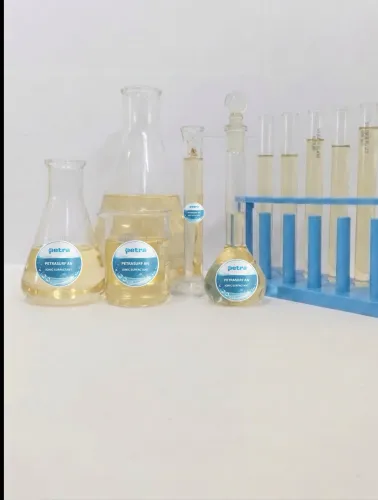
Non-ionic surfactant is a surface-active chemical used in drilling fluids to improve wetting, emulsification, and dispersion of contaminants. It has no electrical charge on its hydrophilic group and can help improve cleaning and compatibility in selected drilling-fluid formulations.
Non-ionic surfactants contain hydrophilic and hydrophobic groups that reduce interfacial tension between different phases. They are used in suitable drilling-fluid formulations as wetting agents, emulsifiers, detergents, and dispersing aids. Their performance depends on the surfactant chemistry, temperature, salinity, pH, and compatibility with the mud system.
Main uses in drilling
i)Wetting agent: Improves wetting of solids and surfaces.
ii)Emulsification: Helps stabilize or form emulsions when appropriately formulated.
iii)Cleaning: Supports removal of oil, grease, and organic contaminants.
iv)Dispersion: Helps distribute selected additives or contaminants throughout the fluid.
v)Fluid compatibility: Can assist formulation performance in suitable water-based or oil-based systems.
Advantages
i)No ionic charge on the hydrophilic group.
ii)Can provide effective wetting and cleaning.
iii)May be compatible with a range of other surfactants.
iv)Can improve emulsification and dispersion when correctly selected.
v)Some grades tolerate electrolytes better than certain ionic surfactants.
FAQ:
Q1. What is a non-ionic surfactant? Answer: A surfactant whose hydrophilic group carries no electrical charge.
Q2. What is its main function in drilling fluids? Answer: To improve wetting, emulsification, cleaning, and dispersion, depending on the formulation.
Q3. Is a non-ionic surfactant water-soluble? Answer: Some grades are water-soluble, while others have limited water solubility. Solubility depends on molecular structure and hydrophilic–lipophilic balance (HLB).
Q4. Can it be used in water-based mud? Answer: Yes, compatible grades can be used to improve wetting, cleaning, or dispersion in water-based drilling fluids.
Q5. Can it be used in oil-based mud? Answer: Certain grades can be used, but they must be selected according to the base oil, emulsifier package, and required emulsion stability.
Q6. What factors affect its performance? Answer: Temperature, salinity, concentration, HLB, mud composition, and compatibility with other additives.